Welcome back to Peru and Its Symbols, our weekly series on the meaning woven into Andean life. Last week we followed the Andean condor up to Hanan Pacha, the world above. This week we come back down to earth, to the guardian of the world we live in: the puma.
Meet the puma
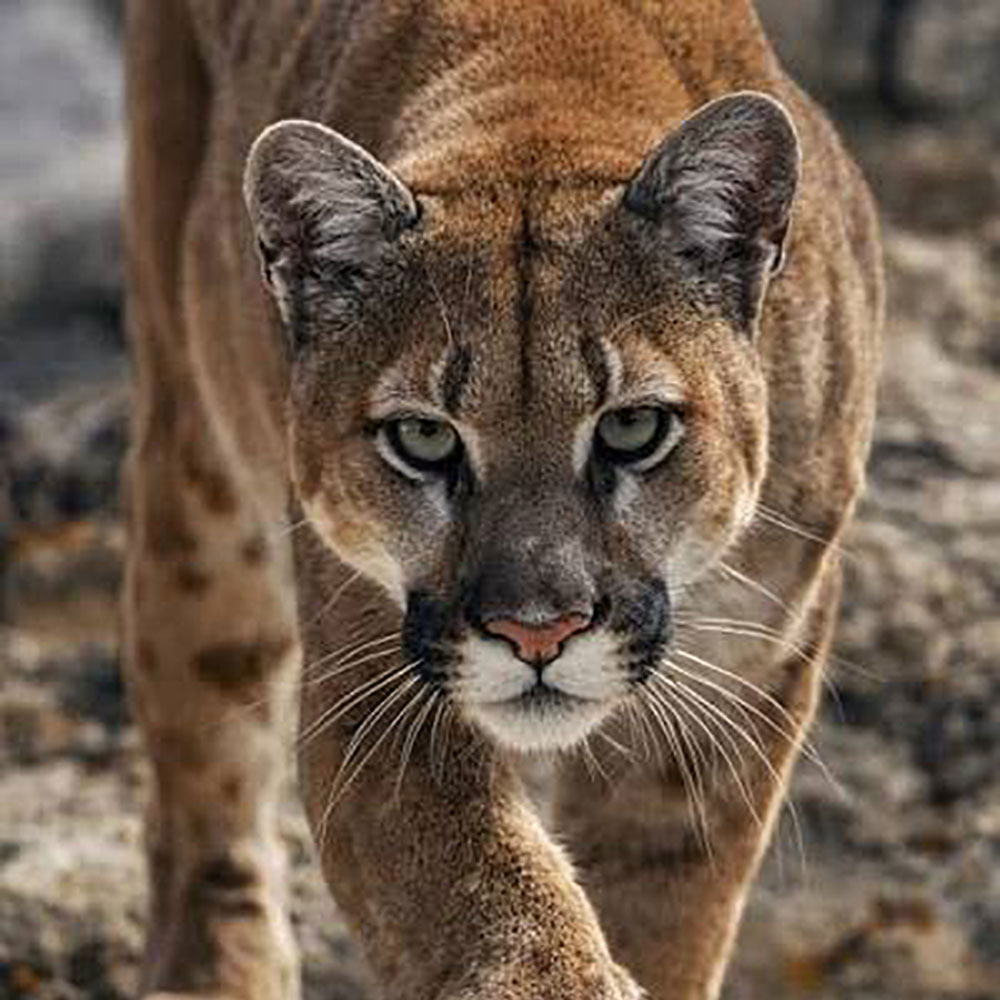
The puma (Puma concolor) is the great wild cat of the Americas. No other large land mammal in the Western Hemisphere covers so much territory: pumas live from Canada all the way to Patagonia, in forests, deserts, grasslands and high mountains. In the Andes they roam from the coastal valleys up to the cold grasslands of the puna, more than 4,000 meters above sea level.
A puma is lean, powerful and built for ambush. Adult males usually weigh between 50 and 70 kilograms, females a little less, and their long, thick tail helps them keep their balance as they leap across rocks and slopes. Their coat is a plain tawny or greyish brown, which is where the Latin name concolor, “of one color,” comes from. Pumas are solitary and secretive. They hunt mostly at dawn and dusk, and in the Andes their prey includes vicuñas, guanacos, deer and vizcachas.
Unlike lions or jaguars, pumas cannot roar. Instead they purr, hiss, growl and make high whistling calls. And they go by many names: cougar, mountain lion, panther or catamount in North America, and león in many parts of South America.
A word from the Andes
The name we use today comes from Quechua. Puma is the word the Andean peoples have always used for this cat, and Spanish chroniclers carried it to Europe in the 16th century. Today it is the official scientific name of the animal and is used around the world, a small piece of the Inca language that every one of us knows.
Guardian of Kay Pacha, the world we live in
As we saw with the chakana, the Andean cosmos has three levels: Hanan Pacha, the upper world; Kay Pacha, the world of the living; and Uku Pacha, the inner world below. The condor guards the first, the serpent the last, and the puma rules the middle: the world of people, animals, fields and mountains.
That makes the puma a symbol of life on earth and of the strength needed to live it well. In Andean tradition it stands for power, courage, wisdom and self-control, and for the patience of a hunter who waits for the right moment. Inca rulers and warriors identified with the puma, and puma skins were worn in ceremonies and dances as a sign of strength and status.
Together with the condor and the serpent, the puma completes the sacred trio of the Andean world: the sky, the earth and what lies within it.
The puma in ancient Peru
Feline figures appear in Andean art long before the Inca. The temple of Chavín de Huántar, built more than 2,500 years ago in the highlands of Ancash, is decorated with carved heads and fierce figures with feline fangs. Cats also appear in the textiles of Paracas, the ceramics of Nazca and the art of the Moche on the northern coast.
Around Lake Titicaca, the puma was so important that its name may be part of the lake itself. “Titicaca” is often translated as “rock of the puma.” Nearby, in present-day Bolivia, the great site of Tiwanaku includes the temple complex known as Puma Punku, the “Gate of the Puma.”
Cusco, the city shaped like a puma
The most famous puma of all may be a city. According to tradition, the Inca ruler Pachacútec laid out Cusco, the capital of the Inca empire, in the shape of a puma. The great fortress of Sacsayhuamán, on the hill above the city, is said to form the head, its zigzag walls the teeth, and the main square the heart of the animal.
Historians still debate how literally to read this description, which comes to us from colonial-era chroniclers. But the idea lives on in the city’s place names. Where two of Cusco’s rivers meet at the southern end of the old center lies Pumaqchupan, which means “the puma’s tail” in Quechua.
Where to see pumas
Pumas are shy and hard to spot, and most people who live in their territory never see one. In Peru they are found in national parks and highland reserves, but sightings are rare. The best place in the Andes to see a wild puma is farther south, in Torres del Paine National Park in Chilean Patagonia, where local trackers lead small groups to watch them hunt across the open steppe.
A symbol worth protecting
Thanks to its huge range, the puma is listed as a species of Least Concern by the International Union for Conservation of Nature. Even so, its populations are declining in many areas because of habitat loss, roads and conflict with ranchers who lose livestock. In the Andes, projects that help herding communities protect their animals are helping people and pumas share the land.
Bringing the spirit of the puma home
For the Andean peoples, the puma is a reminder to stand firm in the world we live in, to act with courage and patience, and to respect the land that sustains us. That same respect for the earth lives on in the work of Andean artisans, from the silversmiths behind our Ilaria jewelry, handcrafted in Peru, to the weavers of our alpaca ponchos with Inca designs. Bring a piece of the Andes home, and carry a little of the puma’s strength with you.
Next week in Peru and Its Symbols: the amaru, the serpent of the inner world.