Welcome to Peru and Its Symbols, a new weekly series on the Andes Luxe blog. Peru is a country where meaning is woven into almost everything: the patterns on a poncho, the shape of a temple wall, the little ceramic bulls that sit on village rooftops. Each week we will take one symbol and look at where it comes from, what it means, and how it lives on today. It is a vast subject, so we will go one step at a time, and there is no better place to begin than with a symbol made of steps.
What is the chakana?
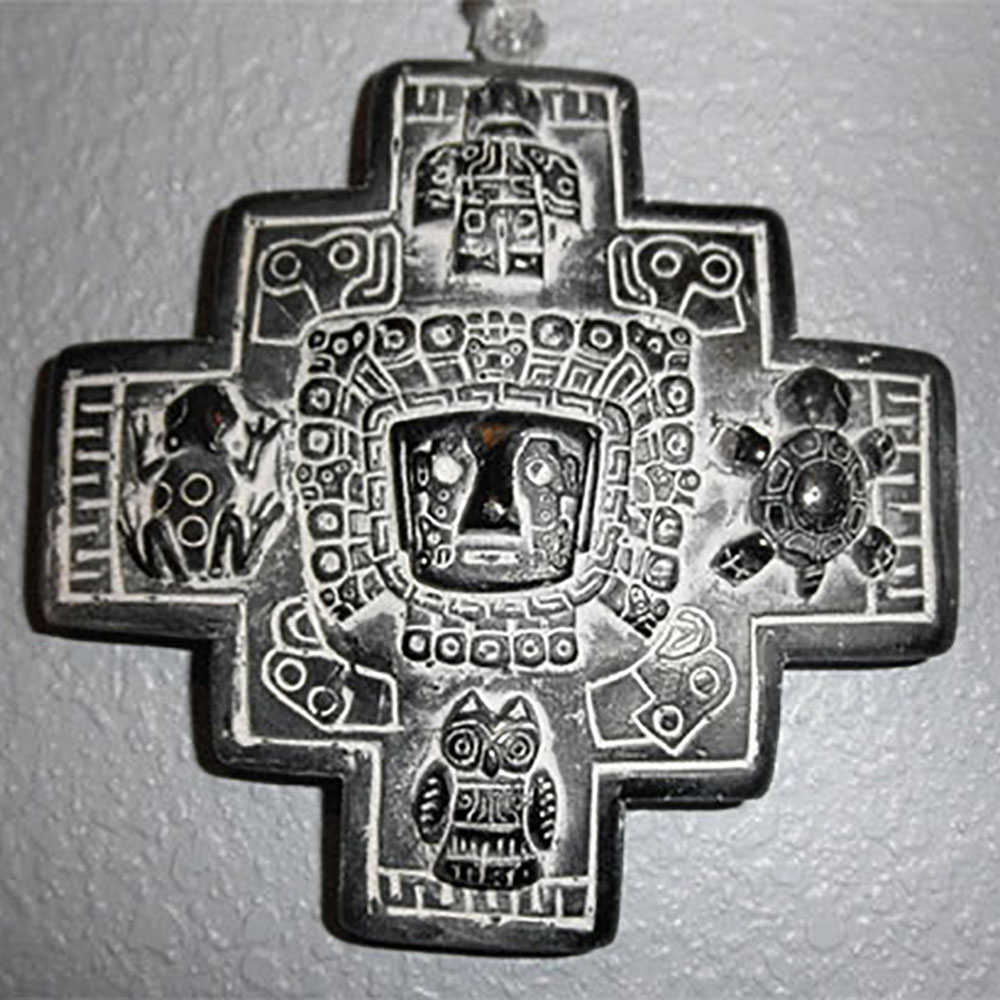
The chakana, also called the Andean cross or Inca cross, is a stepped, equal-armed cross with a circle at its center. Each of its four arms is built from three steps, giving the figure twelve outer points. You will see it carved into stone at Inca sites, woven into textiles, painted on ceramics and, very often, worn as a pendant.
The symbol is older than the Inca Empire. Versions of the stepped cross appear in earlier Andean cultures, and the Inca adopted it and gave it a central place in their way of seeing the world. Today the chakana is used across Peru, Bolivia and the wider Andes as a sign of Andean identity.
Where does the name come from?
The word is usually traced to the Quechua chakay, meaning “to cross” or “to bridge.” That idea of a bridge is the key to the symbol: the chakana is understood as a link between worlds, between people and nature, and between the earth and the sky.
It is also closely tied to the night sky. Many sources connect the chakana with the Southern Cross, the constellation that guides travelers in the Southern Hemisphere and that the Andean peoples watched closely to mark the seasons.
The three worlds: Hanan Pacha, Kay Pacha and Uku Pacha
The three steps on each arm are most often read as the three levels of the Andean universe, each with its guardian animal:
- Hanan Pacha, the upper world. The realm of the sun, moon, stars and the gods, represented by the condor, which flies between earth and sky.
- Kay Pacha, the world we live in. The everyday world of people, crops and animals, represented by the puma, a symbol of strength and life energy.
- Uku Pacha, the inner world. The world below the surface, of seeds, springs and ancestors, represented by the serpent. It is not a place of punishment, but a source of renewal where new life begins.
The condor, the puma and the serpent are symbols in their own right, and each will get its own post in this series.
The four directions and the center
The four arms of the cross point to the four directions. For the Inca, this echoed the four regions of their empire, Tawantinsuyu, which means “the four parts together.” The circle in the middle is often described as the center that holds everything in balance, and it has been associated with Cusco, the Inca capital that was considered the navel of the world.
Some interpreters also read the chakana’s halves as pairs of complementary forces: masculine and feminine, upper and lower, time and space. Interpretations vary from community to community and from scholar to scholar, and much of what is written about the chakana today blends ancient tradition with modern spiritual reading. What stays constant is the core idea of balance and connection.
Reciprocity: the values behind the symbol
The chakana is closely tied to Andean values that are still very much alive. The most important is ayni, reciprocity: the principle that what you receive, you give back, whether to your neighbors, to your community or to Pachamama, Mother Earth. In that sense the chakana is not only a map of the cosmos but also a reminder of how to live well with others.
In many Andean communities the cross is celebrated in early May, when the Christian Feast of the Cross and much older Andean traditions came together, one of many examples of how Andean and Catholic beliefs have blended over the centuries.
Where to see the chakana in Peru
If you travel to the Cusco region, keep an eye out for stepped designs on Inca stonework. At Ollantaytambo, the stepped motif appears near the Temple of the Sun and at the fountains known as the Princess Baths. At Machu Picchu, guides often point out a stepped stone in the Temple of the Three Windows that is read as half of a chakana. And in Cusco’s markets and workshops you will find the symbol everywhere, from silver pendants to woven belts.
The chakana today
For many people in the Andes, wearing a chakana is a way of honoring their heritage. For visitors, it is a meaningful keepsake: a reminder of balance, of the connection between people and nature, and of the bridge between where we come from and where we are going.
The same geometric spirit runs through Andean craft, from the stepped patterns woven into alpaca textiles to the work of the region’s silversmiths. Explore our handcrafted jewelry and our alpaca capes and ponchos to bring a piece of the Andes home.
Next week in Peru and Its Symbols: the condor, guardian of the upper world.