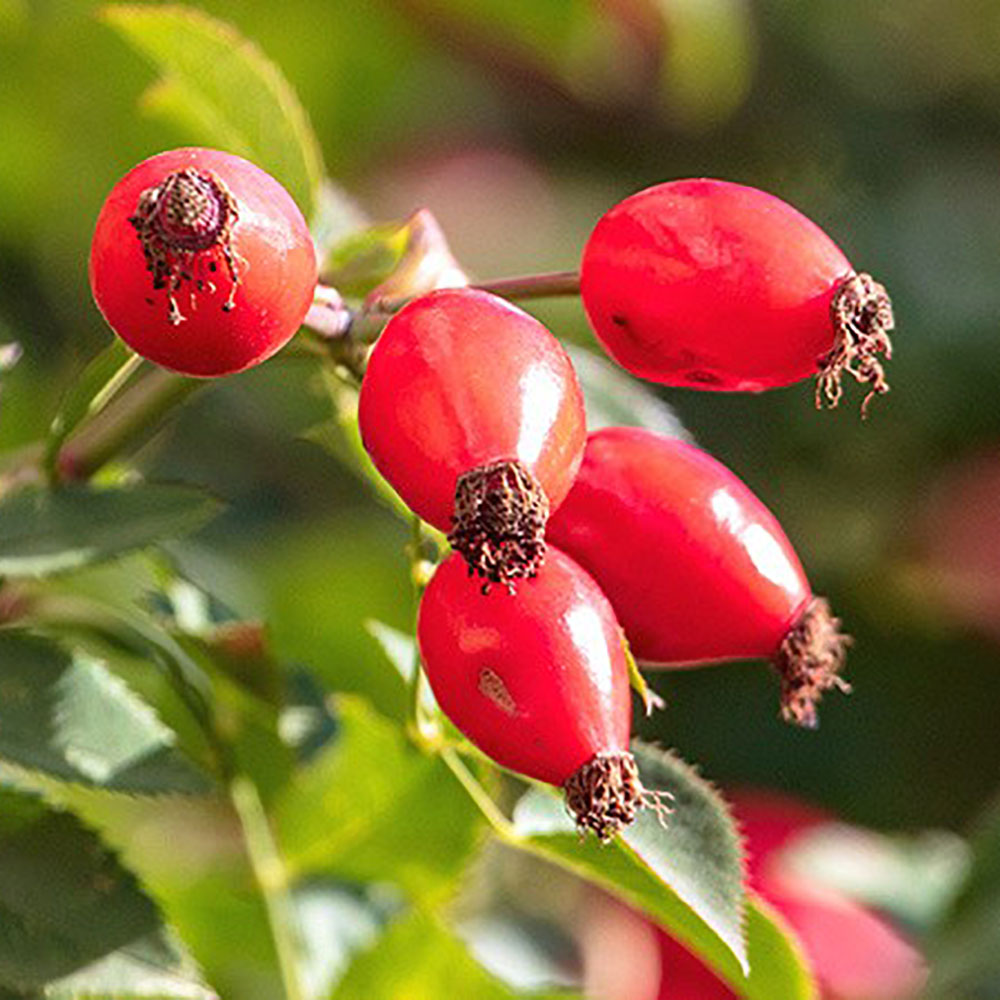
Drive through the countryside of southern Chile in late summer and you will see them along roadsides, fences and hillsides: tangled bushes covered in small, bright red-orange fruits. These are the hips of the rosa mosqueta, the wild rose behind one of the world’s best-loved skin care oils. Here is the story of the plant, the people who harvest it, and the golden oil it produces.
A rose that came from far away
Although rosehip oil is now closely associated with Chile, the rosa mosqueta is not native to South America. Wild roses were brought from Europe during the colonial period, and the plants found the cool, rainy climate of southern Chile so much to their liking that they spread across the landscape and became naturalized.
“Rosa mosqueta” is the common name used in Chile for several closely related wild roses, most importantly Rosa rubiginosa (also known as Rosa eglanteria, or sweet briar) and Rosa canina, the dog rose. Today these roses grow over a wide stretch of the country, from the central valleys down into Patagonia, but they are especially abundant in the south, in regions such as La Araucanía, Los Ríos and Los Lagos.
From blossom to fruit
In spring the bushes are covered in simple pink and white flowers with five petals. Once the petals fall, the base of each flower swells into a fruit called a hip. Over the summer the hips ripen from green to a deep red-orange, and from late summer into autumn, roughly February through April in the Southern Hemisphere, they are ready to be picked. Inside each hip are dozens of small, hard seeds, and those seeds are the source of rosehip oil.
A harvest carried out by hand
For generations, much of Chile’s rosehip has been gathered from wild plants by rural families. Harvesting is hard work: the bushes are thick with thorns, and the fruit is picked by hand or with simple tools, often by whole families who sell the hips to local collectors. For many communities in the south, including Mapuche families, the rosehip season provides an important extra source of income each year.
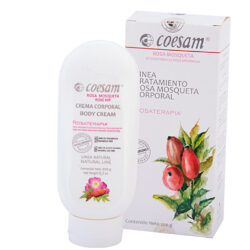
Chile’s rosehip industry grew out of this wild harvest. One of its pioneers was Coesam, the Chilean company whose rosehip products we carry, which began in 1974 by exporting dried rosehips to Germany for use in food products. As demand grew, companies like Coesam also developed their own plantations of selected varieties, allowing for more consistent quality alongside the traditional wild harvest. Today Chile is one of the world’s leading producers and exporters of rosehip.
How rosehip oil is made
After harvest, the hips are dried and the seeds are separated from the fleshy shell. The shells are used for products such as rosehip tea, while the seeds go on to oil extraction.
The most prized method is cold pressing, in which the seeds are mechanically pressed without added heat. This gentle process helps preserve the oil’s natural compounds and gives it its characteristic golden to amber color and light, earthy scent. Rosehip oil can also be extracted by other methods; refined oils tend to be paler and have less scent.
It takes a large quantity of seeds to make a small amount of oil, which is one reason pure rosehip oil is treated as a precious ingredient.
Why rosehip oil is loved in skin care
Rosehip seed oil is naturally rich in essential fatty acids, especially linoleic acid (omega-6) and alpha-linolenic acid (omega-3), which help support the skin’s natural moisture barrier. It also contains carotenoids, which give the oil its golden tone, and tocopherols (vitamin E), natural antioxidants.
Thanks to this profile, rosehip oil is popular for:
- Dry and dehydrated skin, helping to soften and nourish without a heavy, greasy feel.
- Improving the look of fine lines, as part of a regular evening routine.
- The appearance of scars and stretch marks, one of its most traditional uses in Chile.
- Uneven tone and dull skin, helping skin look brighter and more even over time.
- Hair and nails, adding shine to dry ends and softening cuticles.
As with any skin care ingredient, results vary from person to person, and consistency matters more than quantity.
How to use rosehip oil
- On the face: after cleansing, warm two or three drops between your fingertips and gently press them into slightly damp skin, at night or in the morning under sunscreen.
- On the body: massage into dry areas, scars or stretch marks once or twice a day.
- Mixed in: add a drop to your usual moisturizer for extra nourishment.
- Patch test first: if you have sensitive skin, try a small amount on your inner arm before using it on your face.
Rosehip oil is sensitive to light, heat and air. Keep it tightly closed in its dark bottle, store it in a cool place and use it within the time recommended on the label.
A gift from the south of Chile
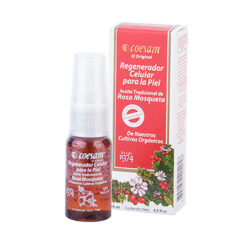
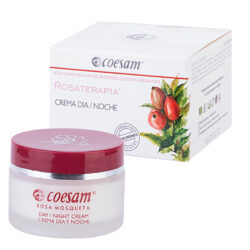
Every bottle of Chilean rosehip oil carries a story: a European rose that made a new home in the Andes, the families who brave the thorns each autumn, and a tradition of natural skin care that has traveled around the world. Discover our rosehip skin care collection, including Coesam Organic Rosehip Oil, Coesam Traditional Rosehip Oil and the soothing rosehip tea made from the fruit’s shell.